
Reviewed · THIRD REICH & WWII HISTORY TOURS
Munich: Birthplace of the Third Reich Guided Walking Tour
Hitler’s rise reads differently when you stand on the streets. This guided walk connects Munich landmarks to the propaganda, plotting, and violence that fed the Third Reich.
I like two things a lot: the beer hall stops that show how ideas gained traction in real public spaces, and the memorial focus that keeps the story anchored to victims and opponents of Nazism. It is not just walls and dates.
The only real drawback is the subject matter. You will be walking and listening for 2.5 hours through anti-Semitism, Kristallnacht, and Holocaust-related violence, so it helps to be ready for heavy facts and respectful silence when needed.
In This Review
- Key things you will notice on this Munich Third Reich walk
- Why Munich Matters for the Third Reich Story
- The 2.5-Hour Walking Route and What the Format Does for You
- Starting at Radius Tours Office: A Practical Beginning in the Center
- Beer Halls and Early Nazi Speeches: Where Power Learned to Perform
- Goebbels, Kristallnacht, and the Shift from Words to Violence
- Nazi Headquarters and War-Scarred Buildings: Power in Ordinary Sight
- Monuments, Victims, and Opponents: What Remembrance Looks Like on the Ground
- Guides, Questions, and the Pace That Keeps You Oriented
- Price and Value: Is $29 Actually a Fair Deal?
- Tips So You Get More From a Tour This Heavy
- Who This Tour Fits Best (and Who Might Skip It)
- Should You Book This Munich Third Reich Guided Walk?
- FAQ
- How long is the Munich Third Reich guided walking tour?
- What is the price per person?
- Where do I meet for the tour?
- Is the tour in English?
- Do I need hotel pickup?
- Is transportation to the historic center included?
- Is there a guide on the tour?
- What can I see during the tour?
- What is the cancellation policy?
Key things you will notice on this Munich Third Reich walk
- Beer halls tied to early Nazi gatherings: watch how public rooms helped turn fanatics into a movement.
- A standing-point for Goebbels and Kristallnacht planning: you’ll connect propaganda to coordinated action.
- Official Nazi Headquarters in the route: you see how power operated close to everyday city life.
- War damage contrast: central Munich is not uniform; many Nazi-era buildings endured where other areas were hit hard.
- Monuments for victims and opponents: the walk ends by pointing you at remembrance, not just history lessons.
- Guides who handle hard material in a human tone: you’ll often find room for questions and a careful balance of empathy and humor.
More walks tracing Munich Third Reich and wartime history
- Munich: Third Reich & WWII Walking Tour★ 4.6 · 6,181 reviews
- Third Reich Walking Tour Munich★ 4.5 · 4,291 reviews
- Munich: Birthplace of the Third Reich Guided Walking Tour★ 4.6 · 771 reviews
- Munich World War II Sites Including Dachau Concentration Camp★ 4.5 · 570 reviews
Why Munich Matters for the Third Reich Story
Munich is where the Nazi movement gained momentum early, long before the world understood what that momentum would become. This tour is built around that uncomfortable truth: ideology did not start in a vacuum. It started in meeting rooms, speeches, local street fights, and places where ordinary people could hear and watch power take shape.
I also like that the walk treats Munich like a living place, not a museum. You look at buildings and street corners and ask yourself how something so monstrous could grow in plain sight. The guide’s job is to stitch those moments together clearly, including the step-by-step rise that led to violence.
The 2.5-Hour Walking Route and What the Format Does for You
This is a 2.5-hour guided walking tour in English, with the guide leading the whole way. Hotel pickup is not included, so you plan to meet at the Radius Tours office and then travel to the historic center as part of what’s provided.
That time window is a smart choice for this topic. You get enough stops to understand the sequence—early organizing, propaganda, escalation—without the fatigue of an all-day history slog. You’ll also benefit from the guide’s pacing on a route that includes emotionally difficult themes.
The walk is heavy on information, but it is not just lecturing. You’re shown specific places tied to key events, and then the guide translates what you’re seeing into plain context: what happened there, who was involved, and how it contributed to the bigger machine of Nazism.
Starting at Radius Tours Office: A Practical Beginning in the Center
You meet at the Radius Tours office. From there, the tour includes transportation to the historic center of Munich, which matters because you do not want to spend your limited time figuring out how to get to the main sites on your own.
Come ready to walk right away. This is the kind of tour where shoe choice matters because you are standing still at memorials and looking up at buildings, then moving again quickly to connect the next point in the story.
Also, this topic asks for focus, not sightseeing mode. You’ll get more out of it if you give the guide your full attention early, especially around the first stops tied to early gatherings and speeches.
More laps of the Altstadt and Marienplatz
- Munich: Old Town & Viktualienmarkt City Walk in German
★ 4.7 · 2,304 reviews - Munich: Night Watchman Walking Tour
★ 4.7 · 2,092 reviews - Munich Ghosts and Spirits Evening Walking Tour
★ 5.0 · 1,900 reviews
Beer Halls and Early Nazi Speeches: Where Power Learned to Perform
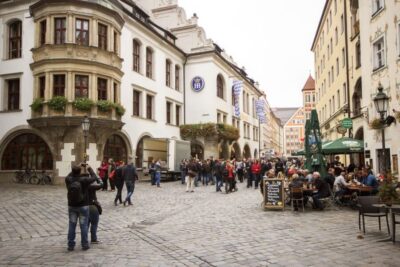
One of the strongest parts of this tour is the attention to the beer halls—not as quaint Bavarian scenery, but as political stages. You visit the kind of rooms where Hitler held first party meetings and speeches, and you learn how those spaces gave a fringe movement legitimacy through repetition, public attention, and the theater of nationalism.
This is where the history becomes concrete. It’s easy to read about propaganda in a book. It’s harder—and more informative—to stand where people gathered, listened, and reacted to a message that was being built to grow.
Pay attention to the guide’s explanation of how Nazi ideology worked in public. The point is not just that speeches happened. It’s that speeches were recruitment tools, and recruitment tools turned into street power. The tour ties this directly to Munich’s street-level struggle, including clashes associated with Hitler and the Brownshirts.
If you’re the type who wants the why behind the what, this is the section that clicks. You start to see how a movement uses everyday social spaces to spread its message.
Goebbels, Kristallnacht, and the Shift from Words to Violence
Next comes the moment that makes the story turn sharp and dark. The tour includes a stop at the building where Goebbels plotted the Night of Broken Glass. Standing there shifts the conversation from politics to coordinated brutality.
You learn how Kristallnacht was a milestone on the road to the Holocaust. That phrasing can feel distant on paper. In a guided walk, it becomes specific: you are shown how anti-Semitism was not only a belief system but also a plan carried out through state-linked propaganda and organized action.
This is also where the guide’s tone matters. Several English-speaking guides connected with this operator are praised for balancing empathy with humor so the facts don’t become unbearable. That does not mean the tour softens the reality. It means the guide helps you process the information without losing clarity.
When you’re standing at the site tied to planning, take a moment to let the meaning land. If you start rushing for the next photo spot, you’ll miss what makes this stop effective.
Nazi Headquarters and War-Scarred Buildings: Power in Ordinary Sight
The walk then moves into areas connected with the official structures of Nazism, including Nazi Headquarters. You’re shown the official headquarters, and you also see other buildings with the scars of the Second World War—important because Munich is not a single uniform backdrop.
Allied bombing devastated large parts of central Munich, but many Nazi-era buildings survived. The contrast is unsettling. It shows how physical space can outlast the ideology that used it. You’ll likely notice how the city keeps going around old power structures, which raises an honest question: what does a society do when reminders remain in place?
This part of the tour helps you understand the machinery side of Nazism: it wasn’t only marches and speeches. It involved offices, planning, and bureaucracy—systems built to turn ideology into action.
If you have studied WWII before, you still get something here. The walk helps you match your timeline to actual corners and facades. If you haven’t studied it much, you’ll still understand the sequence because the guide keeps returning to the same theme: small beginnings, escalating control, then catastrophic violence.
Monuments, Victims, and Opponents: What Remembrance Looks Like on the Ground
A key strength is that the tour does not end at sites tied to perpetrators. You also visit monuments honoring victims and opponents of Nazism, which changes how the story lands in your mind.
This is where you should slow down a little. Memorials invite a different kind of attention than political buildings do. The guide’s explanations help connect names, suffering, and resistance to what you just saw in the earlier stops.
You’ll also get help framing the anti-Semitism you encounter in the story. The tour is explicit about facing the reality of persecution and the memory of its victims. That matters because it keeps the tour from becoming a purely academic lesson.
If you care about how history is remembered in Germany, you’ll appreciate that the route includes both the locations of power and the places built for remembrance. It’s a reminder that telling the truth includes honoring who was harmed and who tried to stop it.
Guides, Questions, and the Pace That Keeps You Oriented
The tour runs on a live English guide, and the guides associated with this experience are frequently praised for clarity and for making it easier to handle heavy material. You’ll often hear small moments where the guide answers questions directly and connects dots between stops so you don’t feel lost.
I also like that some guides use practical teaching tools. One guide is mentioned for bringing binders of photos, which helps you picture what the streets and buildings looked like during the Third Reich era. Even if you have a strong imagination, it helps to see the connection between then and now without guessing.
On top of that, the guide’s ability to keep the group moving matters. A few people mention that the tour can work around crowds in the busiest central areas, which is a real comfort. You spend less time standing around and more time learning.
Bring a question or two if you have them. If you’ve wondered how ordinary people responded, how propaganda spreads, or how resistance formed, ask early. A good guide will use your curiosity to shape the explanation.
Price and Value: Is $29 Actually a Fair Deal?
At $29 per person for a 2.5-hour guided walk, this is priced like a budget-friendly history tour, not a premium museum experience. The value comes from what’s included: the guide, the tour itself, and transportation to the historic center of Munich.
That transportation detail is not minor. It means you can focus on the content instead of wasting time managing transit while your schedule is tight. And because it’s a walk-and-stop format, the guide’s time is the main product you’re paying for.
The math only works if you’re the kind of traveler who wants context in real places. If you just want photos of historic buildings with minimal interpretation, you might feel the cost does not match your expectations. But if you want the story stitched together—especially the rise of the Nazi Party in Munich—this is strong value for a short time on the calendar.
Tips So You Get More From a Tour This Heavy
This is not a casual “see the city” walk. It’s a structured history route through sites tied to propaganda, anti-Semitism, and political violence.
Here’s how to make it easier on yourself:
- Wear comfortable shoes you can stand in for a while, since memorial stops often mean lingering.
- Dress for Munich weather. Several people describe cold or rainy days, and you stay outside for the full 2.5 hours.
- Bring a small bottle of water if you can. The data doesn’t promise a drink stop, and you’ll thank yourself later.
And one more practical point: save your major museum day for another time. This tour is intense in a way that makes it hard to switch gears right after.
Who This Tour Fits Best (and Who Might Skip It)
This tour fits best if you want a clear, street-level understanding of how Nazism rose in Munich, including Hitler’s early speeches and planning linked to Kristallnacht. If WWII history matters to you, or if you’re traveling with curiosity about how a movement gained followers, you’ll likely find the pacing and stop selection satisfying.
You might consider skipping if:
- You’re not comfortable hearing detailed information about anti-Semitism and violence.
- You hate walking tours and get mentally drained by dense explanations.
- You are looking for a light, entertainment-first city experience.
It’s also a good pick for solo travelers and couples who want a guided storyline without needing museum tickets. You get a sequence you can remember, not just random facts.
Should You Book This Munich Third Reich Guided Walk?
If you’re in Munich for a short time and you want the essential locations connected to the Nazi movement’s start in the city, I’d book this without overthinking it. The route covers the basics in a way that makes cause and effect easier to grasp: early meetings and speeches, escalation toward violence, and then memorial remembrance.
Book it if you value a careful guide and you’re ready for a difficult but important topic presented with respectful pacing. Skip it only if you truly want something lighter or you know you won’t handle the subject matter well.
If you do book, go in with one goal: learn how Munich’s street corners and public rooms helped turn ideology into action, and why the memorials you see afterward matter just as much as the buildings tied to power.
FAQ
How long is the Munich Third Reich guided walking tour?
The tour lasts 2.5 hours.
What is the price per person?
It costs $29 per person.
Where do I meet for the tour?
Meet at the Radius Tours office.
Is the tour in English?
Yes, the live guide provides the tour in English.
Do I need hotel pickup?
No, hotel pick-up is not included.
Is transportation to the historic center included?
Yes, transportation to the historic center of Munich is included.
Is there a guide on the tour?
Yes, a live tour guide is included.
What can I see during the tour?
You visit sites connected to Hitler’s early meetings and speeches, a building tied to Goebbels and the Night of Broken Glass, Nazi Headquarters, and monuments honoring victims and opponents of Nazism.
What is the cancellation policy?
Free cancellation is available up to 24 hours in advance for a full refund.
More Altstadt and Marienplatz Walks

More Third Reich and WWII History in Munich


Just added to the Munich Explorer notebook
Third Reich & WWII History Tours, compared.
 ★ 4.6Third Reich & WWII Walking TourFrom $316,181 reviews
 ★ 4.5Third Reich Walking Tour MunichFrom $454,291 reviews
 ★ 4.5Munich World War II Sites Including Dachau Concentration CampFrom $105570 reviews
 ★ 5.0Munich City Walking Tour, includes Third Reich & ViktualienmarktFrom $31458 reviews
 ★ 4.5Third Reich & WWII Walking TourFrom $35417 reviews
 ★ 4.9Munich 3-Hour Segway Tour: Nazi Munich & Royal ArchitectureFrom $91194 reviews
 ★ 5.0Dachau Concentration Camp Memorial Site And Third Reich Day Tour From MunichFrom $145185 reviews
 ★ 5.0Munich in the 3rd Reich and WW2 private walking tourFrom $423148 reviews
Browse the lists this tour appears in