
Reviewed · SELF-GUIDED TOURS
A Self-Guided Bavarian Tour of Munich’s Hidden Wonders
Munich rewards slow wandering, and this self-guided audio walk helps you do it. You start at Marienplatz and work your way through cathedral domes, royal palaces, major art stops, beer-hall culture, and Olympic architecture, all at your pace. The best part is the structure: you get enough route guidance to stay on track, without feeling herded.
I like two things right away. First, the route hits real “Munich stuff” you’d otherwise have to research: places like the Frauenkirche, the Residenz, and the Deutsches Museum show up in the right order. Second, the price is strikingly low for a 6.5-hour loop with an audio app and a mobile ticket.
One drawback to plan for: the audio app can be temperamental. One report described constant troubleshooting and audio that was too quiet to understand, which can cost you time and patience—so I’d test your setup before you commit to the walk.
In This Review
- Key Highlights That Make This Tour Worth Your Time
- How This 6.5-Hour Munich Loop Feels on the Ground
- Starting at Marienplatz: New Town Hall and the Glockenspiel Moment
- The Frauenkirche Twin Domes: A Cathedral You Can Spot From Anywhere
- Alter Peter and the 299 Steps: Earned City Views
- Viktualienmarkt: Munich Food Market Reality Check
- Hofbräuhaus: Beer Hall Culture Without Needing a Long Night
- Residenz and Odeonsplatz: Wittelsbach Power and a Dark 1923 Site
- Parks as a Reset Button: Englischer Garten and Hofgarten
- Art Stops You Can Handle: Alte Pinakothek, Königsplatz, and More
- Karlsplatz (Stachus), Deutsches Museum, and the Munich Brains Tour
- Olympiapark and the Olympic Tower: Modern Munich With Big Views
- Using the App Smoothly: The One Thing That Can Make or Break It
- Price and Value: Why $3.58 Can Still Be a Smart Move
- Who This Tour Suits Best
- Should You Book This Munich Hidden Wonders Audio Walk?
- FAQ
- How long is the self-guided Munich tour?
- Where does the tour start and end?
- What does the price include?
- Are there any museum admission fees included in the tour price?
- Is this tour guided by an in-person guide?
- Is the audio tour private for my group?
- Can I cancel for a full refund?
Key Highlights That Make This Tour Worth Your Time
- Flexible, self-paced routing: you control how long you linger at each stop
- Audio guidance for big landmarks: Marienplatz, Frauenkirche, Residenz, and more
- A strong mix of sights: old churches, palace power, art museums, and Olympic-era modern design
- Green breaks built in: Englischer Garten and Hofgarten give your legs a reset
- Value that surprises: it’s budget-friendly for the length of the walk and the number of stops
More self-guided routes through Munich
- Munich: Scavenger Hunt Self-Guided Tour for Children★ 4.5 · 101 reviews
- Ghosts of Munich: The Haunted Apprentice Exploration Game★ 4.0 · 19 reviews
- 800 Years of History: A Munich GPS Audio Tour★ 4.5 · 12 reviews
- Munich Scavenger Hunt and Sights Self-Guided Tour★ 4.5 · 8 reviews
How This 6.5-Hour Munich Loop Feels on the Ground
This tour is built for walking and for people who like context while they move. You’re not just looking at famous buildings from the sidewalk—you’re given a guided story through audio at key moments, from Glockenspiel time at Marienplatz to the Olympiapark architecture and panoramic viewpoints.
The route is also smart about pacing. You start in the thick of the historic center, then you gradually widen out. That matters because Munich’s center can feel intense if you try to see everything in one go. Here, you get alternating “stop types”: cathedral and town-square scenes, then markets and beer culture, then palaces, then park time, and finally museum-and-modern-city stops.
At 6 hours 30 minutes, you should plan for a full half day. If you add paid museum interiors (not included in the tour price), you’ll be out longer. If you keep it mostly exterior and quick-entry viewpoints, you’ll likely finish within the advertised time.
Starting at Marienplatz: New Town Hall and the Glockenspiel Moment
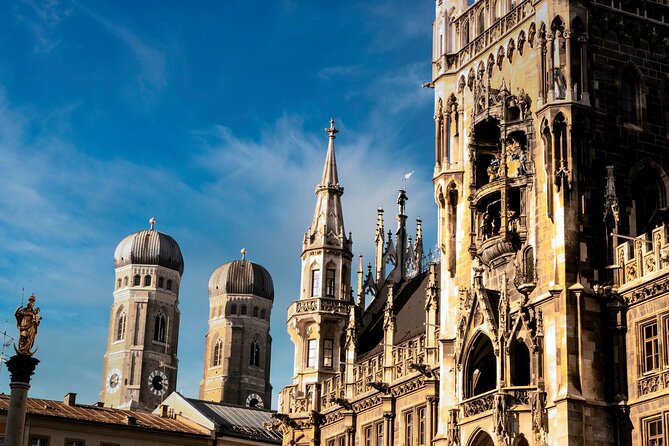
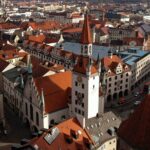
Your tour kicks off at Marienplatz, Munich’s central square. The headline here is the Neo-Gothic New Town Hall, famous for the Glockenspiel that performs daily. Even if you’re not timing it perfectly, standing in this square gives you the right “Munich mood”: town-center energy, historic architecture, and a lot of pedestrians funneling past the same views.
Practical tip: arrive with a little time buffer. If you’re lucky, you’ll catch the clock show. If not, you’ll still benefit from the audio context that explains why this square matters and how the New Town Hall fits into Munich’s identity.
This is also a good place to get your bearings fast—then you can move on without feeling lost when the route starts stacking attractions closely.
The Frauenkirche Twin Domes: A Cathedral You Can Spot From Anywhere
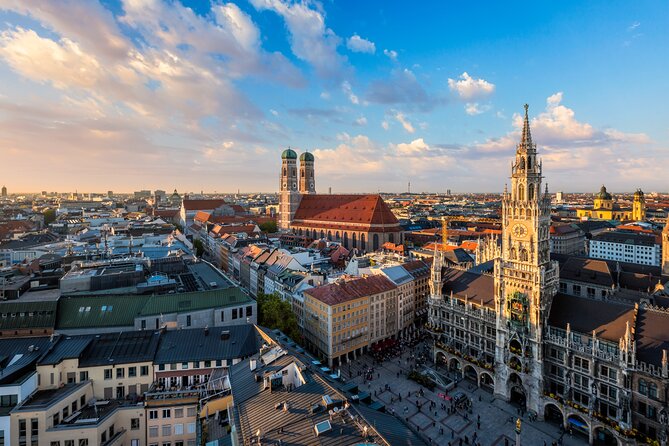
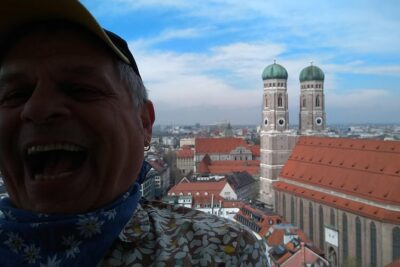
Next comes the Frauenkirche, Munich’s iconic cathedral with its twin onion domes. Built in the 15th century in Gothic style, it’s designed to be seen and remembered. The scale is huge too, with capacity listed at 20,000 people—so even when you’re just looking at it from outside, you’re dealing with a major civic-religious landmark.
Why this stop is valuable on an audio route: cathedrals can feel like “pretty buildings” if you only look at the exterior. The audio guidance helps you connect the architecture to the city’s long story, not just the photo angle.
If you’re the kind of traveler who likes details, you’ll also appreciate that this church is one of those Munich “anchor points.” After you know where the domes are, the rest of the day feels easier.
- From Munich: Neuschwanstein & Linderhof Castle Full-Day Trip
★ 4.6 · 14,646 reviews - Neuschwanstein & Linderhof Castle-Fairytale Day Tour from Munich
★ 4.5 · 7,275 reviews - Munich: Third Reich & WWII Walking Tour
★ 4.6 · 6,181 reviews
Alter Peter and the 299 Steps: Earned City Views
From there, you head to Alter Peter, Munich’s oldest parish church. The main reason to care is the tower viewpoint: climb 299 steps to an observation deck for panoramic views.
This is one of those “you decide your effort level” stops. If you’re feeling good on the stairs, do it. If not, you can still treat it as a landmark break—just know the payoff is the view after the climb.
Timing note: towers can take time even when they aren’t complicated. Plan a few extra minutes so you don’t rush the descent or miss your next audio segment.
Viktualienmarkt: Munich Food Market Reality Check
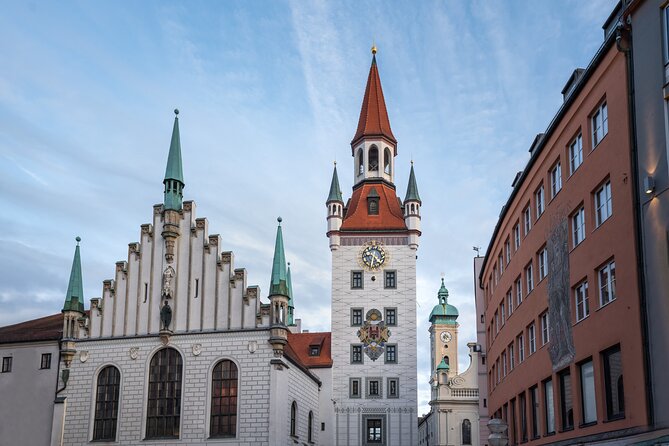
At Viktualienmarkt, you get a long 1-hour slot in a daily food market that’s been operating since 1807. You’re walking among 140+ stalls selling fresh produce, flowers, and gourmet foods, plus the square includes the official Maypole.
This stop works for two reasons. One, it breaks the heavy-monument rhythm of the earlier blocks. Two, it gives you something tactile—smell, color, and snack potential—rather than just architecture.
If you’re picky about meals during travel, this is a nice place to handle it without turning the day into a complicated itinerary. Grab a small bite, watch people, and then move on with your energy still intact.
Hofbräuhaus: Beer Hall Culture Without Needing a Long Night
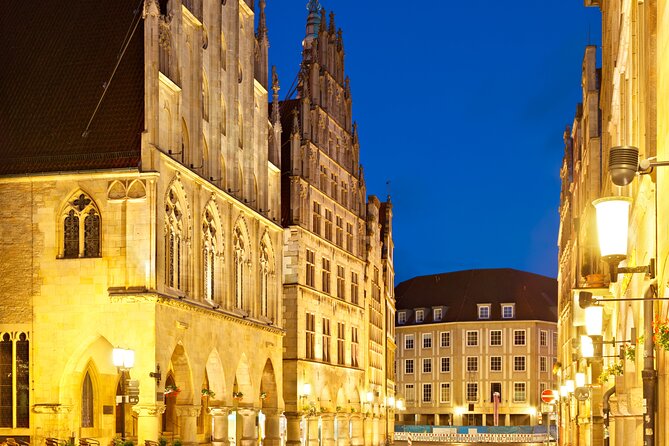
Then it’s Hofbräuhaus, with roots going back to 1589. The key point is that it’s more than a single-purpose beer-stop. The description notes it has hosted notable historical visitors like Mozart and Lenin, and today it’s still a major draw.
Even though this is a “famous place,” I like treating it as a short culture checkpoint, not a marathon drinking session. Think: quick entry into the atmosphere, a sense of how the hall functions as a social room, and maybe one drink if that fits your style.
The audio guidance should help you understand why Hofbräuhaus became a symbol in Munich. With just a 30-minute slot, you’ll get the cultural meaning without letting it swallow your whole afternoon.
Residenz and Odeonsplatz: Wittelsbach Power and a Dark 1923 Site
The tour’s royal chapter centers on the Residenz, the former palace of the Wittelsbach monarchs. It’s described as the largest city palace in Germany, with 10 courtyards and 130 rooms, and it now connects you to the Residenz Museum, treasury, and Cuvilliés-related spaces (museum interiors are separate from the tour price).
This is a strong stop for audio because palaces can feel abstract until you get orientation: what the building represents, how power played out in space, and why the area shaped Munich’s development.
After that, you move to Odeonsplatz. The square features Italian-style architecture and key landmarks like the Feldherrnhalle loggia and the Theatinerkirche. The tour also flags the site’s darker association: it was connected to the failed Beer Hall Putsch in 1923.
That combination matters. Munich isn’t only pretty façades—it’s also political memory. If you want a deeper sense of place, this is one of the stops that can add weight to the day instead of just adding more photos.
Parks as a Reset Button: Englischer Garten and Hofgarten
Midday, you get a breather with the English Garden (Englischer Garten). It’s described as one of the world’s largest urban parks, even larger than New York’s Central Park, with the Eisbachwelle man-made river wave that’s popular with people watching.
This is the kind of stop that helps the whole tour feel doable. After palaces and churches, your body needs space to reset. The park also gives you “Munich at human scale,” with wide paths and open air that make the city feel less like a museum and more like a place locals actually use.
Next is Hofgarten, a Renaissance garden created in the 17th century with a central pavilion dedicated to Diana. It connects the Residenz area toward the English Garden, so it feels like a landscaped corridor between major monuments.
If you’re the type who walks through parks without looking up, this is still worth it. The audio should point you toward the garden features that make these spaces feel designed, not accidental.
Art Stops You Can Handle: Alte Pinakothek, Königsplatz, and More
Once you’re ready for cultural focus again, you hit a cluster of art and museum-area highlights.
First is the Alte Pinakothek, one of the world’s oldest and most important art galleries for Old Master paintings. The descriptions call out artists such as Dürer and Raphael (and others named in the tour info). Because the tour price doesn’t include museum admission fees, treat this as a decide-in-the-moment stop: if you want interior time, you’ll need a separate ticket.
Then comes Königsplatz, a Neoclassical square designed in the style of ancient Athens, envisioned as a cultural center by King Ludwig I. It’s another good “photo and context” setting where audio helps you understand the design idea.
On Königsplatz sits the Glyptothek, described as Munich’s oldest public museum dedicated to ancient Greek and Roman sculpture. It includes noted works like the Barberini Faun.
The route also includes the Lenbachhaus, in the former villa of painter Franz von Lenbach, known for an extensive collection connected with the Blue Rider group. This is a nice counterpoint to the classical sculpture theme—art changes, but the museum area vibe stays coherent.
For museum lovers, this area can become a time sink fast. If you want to stay on the 6.5-hour frame, set a rule for yourself: either you choose 1 interior museum or you keep it to exterior viewing plus quick breaks.
Karlsplatz (Stachus), Deutsches Museum, and the Munich Brains Tour
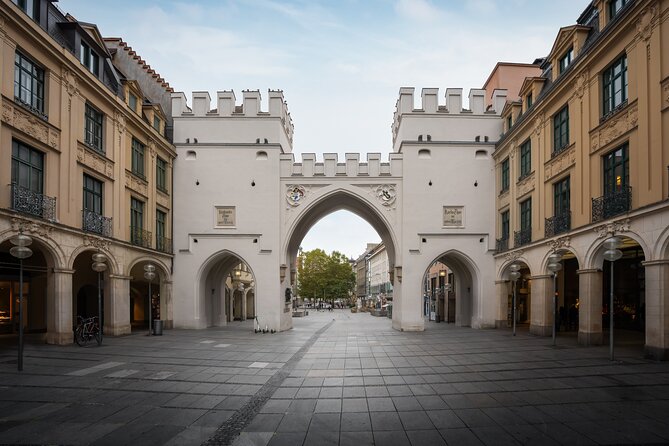
At Karlsplatz, commonly called Stachus, you’re at a major western entrance to Munich’s old town. The square includes a fountain, an underground shopping area, and it acts like a tram hub. This is a practical stop: it makes the next movement easier and gives you a “city navigation checkpoint.”
Then you reach the Deutsches Museum, described as the world’s largest museum of science and technology, with over 28,000 exhibited objects across 50 fields. It also lists interactive exhibits and live demonstrations. If science museums are your thing, this is one of those places where you can easily lose time—in a good way, but still, plan.
The tour info also highlights Maximilianeum, a neo-Renaissance building that seats the Bavarian State Parliament, placed on a hill overlooking the Isar River. Even if you don’t go inside (no admission details are included in the tour price), the viewpoint angle matters.
One more design-focused stop appears here too: the Müllersches Volksbad, an Art Nouveau public bath opened in 1901 with Jugendstil design, and it’s still in use today. This is a wonderful reminder that Munich’s “wow” isn’t only in castles and cathedrals—it’s also in civic architecture.
Olympiapark and the Olympic Tower: Modern Munich With Big Views
Your tour closes with Olympiapark, built for the 1972 Summer Olympics. The architecture is described as tent-like, designed by Frei Otto, and it’s still active for sports, concerts, and leisure.
This is a good ending because it reframes Munich. After all the Gothic and Baroque, you get a modern design landmark that still feels functional, not frozen in time.
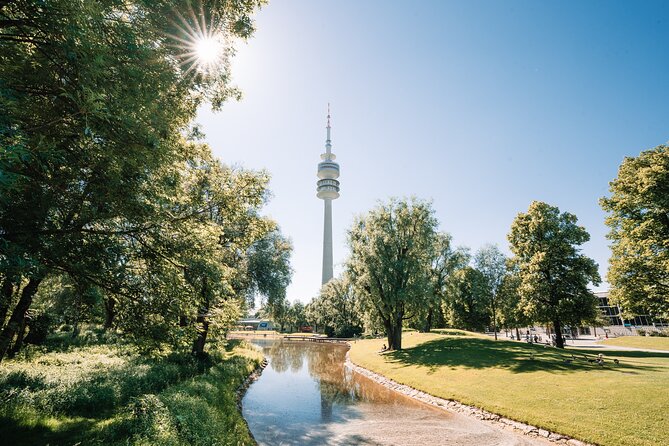
The final “payoff moment” is the Olympic Tower, where you ascend for panoramic views. This is your reward for the walking day: you look back across the city mix you just experienced—historic squares, royal settings, art areas, and park space.
If you’re short on energy, prioritize the view. Skip extra detours and use the audio segments to pace yourself on the approach.
Using the App Smoothly: The One Thing That Can Make or Break It
This is an audio tour, so your success depends on audio quality and basic phone setup.
Here’s what I’d do before you start:
- Check volume and audio output right at the beginning at Marienplatz.
- Keep your phone charged; a 6.5-hour walk can be longer if you stop for photos or snacks.
- If sound gets quiet or the app acts up, don’t treat it as a sunk-cost. Step back, adjust, then jump back in so you don’t burn an hour troubleshooting.
This tour is priced low, and that’s part of the appeal. But low cost doesn’t mean you should fight with technology all afternoon. Get your settings right early, and the audio guidance becomes a real shortcut to understanding what you’re seeing.
Price and Value: Why $3.58 Can Still Be a Smart Move
At $3.58 per person, you’re not paying for guided access to ticketed interiors. You’re paying for a structured route, audio context, and a mobile ticket that keeps the experience simple and on-the-go.
So the value math is straightforward:
- If you mostly stick to outdoor viewpoints, squares, and the guided flow between landmarks, you’re getting a full half-day of help for very little money.
- If you plan to go inside multiple museums or paid attractions, you’ll add extra ticket costs. Still, the audio route can help you choose what matters, instead of buying tickets to everything out of obligation.
Also, the tour is listed as private for your group. That’s not the same thing as a human guide, but it can make the experience feel less chaotic, especially in busy central areas.
Who This Tour Suits Best
This works well if you want:
- A route that keeps you moving without stress
- Audio context at major Munich landmarks
- A mix of architecture, parks, markets, and a science museum stop
It’s also a good fit for people who like flexibility. No fixed pace means you can stop for a coffee near Viktualienmarkt, linger longer around Residenz, or take extra time at the park when your legs ask for it.
If you strongly prefer human guidance or you know you’ll struggle with phone audio, you might find it frustrating. This is best when you’re comfortable using an app and you test it early.
Should You Book This Munich Hidden Wonders Audio Walk?
Book it if you want a structured, low-cost Munich day that stitches together big landmarks in a smart walking order. The route covers the essentials—Marienplatz, Frauenkirche, Residenz, Viktualienmarkt, Hofbräuhaus, major art areas, Deutsches Museum, and Olympiapark—with park time to keep things humane.
Skip it or approach with caution if you’re worried about audio reliability. If your phone tends to have audio issues, do a quick test before you start and bring a fully charged device.
If you’re willing to manage the app setup and you like exploring at your own speed, this is an excellent value way to see Munich beyond the postcard shots.
FAQ
How long is the self-guided Munich tour?
The duration is about 6 hours 30 minutes.
Where does the tour start and end?
It starts at Marienplatz, 80331 München, Germany and ends back at the meeting point.
What does the price include?
It includes the self-guided walking tour through an app and a mobile ticket. Museum and attraction fees are not included.
Are there any museum admission fees included in the tour price?
No. The tour price does not include fees for museums or attractions.
Is this tour guided by an in-person guide?
No. There is no in-person guide; you explore independently with the digital tour app.
Is the audio tour private for my group?
Yes. It’s listed as a private activity, meaning only your group will participate.
Can I cancel for a full refund?
You can cancel for free up to 24 hours in advance for a full refund.
More Self-Guided Routes in Munich



Just added to the Munich Explorer notebook

Self-Guided Tours, compared.
 ★ 4.4Neuschwanstein Castle Skip-the-Line Ticket with Audio GuideFrom $511,388 reviews
 ★ 3.9Füssen: Neuschwanstein Castle Express Ticket and Audio GuideFrom $50788 reviews
 ★ 3.5Neuschwanstein Castle Ticket With Audio Guided TourFrom $54473 reviews
 ★ 4.5Scavenger Hunt Self-Guided Tour for ChildrenFrom $47101 reviews
 ★ 4.0Ghosts of Munich: The Haunted Apprentice Exploration GameFrom $719 reviews
 ★ 4.5800 Years of History: A Munich GPS Audio TourFrom $912 reviews
 ★ 4.5Munich Scavenger Hunt and Sights Self-Guided TourFrom $138 reviews
 ★ 4.5Legendary Breweries of Munich: Self-Guided Puzzle WalkFrom $77 reviews
Browse the lists this tour appears in