
Reviewed · OLD TOWN & MARIENPLATZ WALKS
Fall in Love with Munich in a Private Old Town Walking Tour
Munich clicks faster when it’s explained on foot. This private Old Town walking tour with Victoria – Key to Munich strings together medieval walls, beer-hall lore, and major landmarks in a way that feels personal, not scripted. I especially liked the small-group flexibility (she adjusts to real people, from babies to grandparents) and the way she keeps stories moving with photos and maps on her iPad. One drawback: it’s packed with information, so if you want lots of free time to wander quietly or linger in long museum-style stops, this may feel a bit fast.
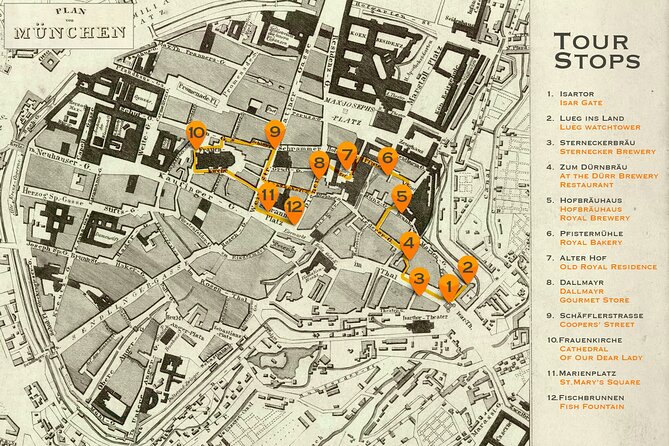
For value, it helps that it’s priced per group (up to 6) for about 2 hours, and it runs in English. You get a digital itinerary map and a guide who ends at the center of things, Marienplatz, where you can keep exploring right away.
Expect a guided walk with entrance fees handled for the stops that require access, plus insider restaurant and shopping tips. What’s not included is food and drinks, so plan to grab a bite after the tour or between major stops if you need it.
In This Review
- Key highlights worth your attention
- Why a private Old Town walk makes Munich feel simpler
- Isar Gate: the start of Munich’s medieval story (and a few jokes)
- Sterneckerbräu: Hitler’s first public speech site, handled with care
- Old taverns and royal baking: Munich’s food stories start early
- Hofbräuhaus München: beer hall interiors, beer purity lore, and the Oktoberfest thread
- Alter Hof courtyard: Wittelsbach power, the Royal Zoo legend, and the flag colors
- Dallmayr and Schäfflerstraße: gourmet tradition and the pest story told through dance
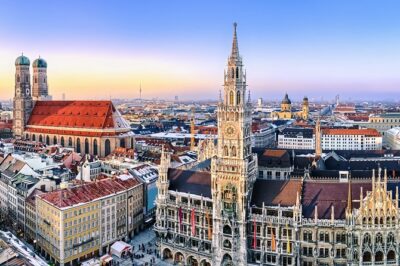
- Frauenkirche: the footprint, the wind lore, and construction legends
- Marienplatz: the Fish Fountain, Glockenspiel scenes, and local traditions you can spot
- What the tour feels like in real life: pace, visuals, and comfort
- Price and value: when $157.28 per group is a smart move
- Who should book this Munich Old Town tour
- Should you book this tour?
- FAQ
- How long is the private walking tour?
- What is the group size limit?
- Where does the tour start and end?
- Is the tour offered in English?
- Is there a map provided?
- Are entrance fees included?
- Does the tour include food or drinks?
- What’s the meeting point like?
- Is the guide able to support different ages?
- What should I do after the tour ends at Marienplatz?
Key highlights worth your attention
- Isar Gate meeting point: start right at the medieval fortifications, then build the story forward
- Hofbräuhaus interior time: see key spaces and learn the Bavarian brewing rules that shaped beer culture
- Beer-hall and city legends: details like a beer angel and why stories stick around
- Frauenkirche specifics: construction legends, the Devil’s footprint, and the cathedral’s wind lore
- Marienplatz old-town rhythm: Fischbrunnen, Glockenspiel scenes, and local traditions around the square
More laps of the Altstadt and Marienplatz
- Munich: Third Reich & WWII Walking Tour★ 4.6 · 6,181 reviews
- Third Reich Walking Tour Munich★ 4.5 · 4,291 reviews
- Munich: Old Town & Viktualienmarkt City Walk in German★ 4.7 · 2,304 reviews
- Munich: Night Watchman Walking Tour★ 4.7 · 2,092 reviews
Why a private Old Town walk makes Munich feel simpler
Munich is beautiful, but it can be confusing at first. Streets look similar, names repeat, and the important buildings blend into the scenery. A private tour fixes that. You get one guide, one pace, and a storyline that connects the places you’re seeing.
This tour also gives you more than photos-on-a-phone sightseeing. Victoria walks you through what each stop meant back then, and why it still matters now. That turns a list of landmarks into cause-and-effect: walls created a city, trade shaped growth, brewing shaped culture, and the center square became the stage for public life.
The other thing I like for first-timers: you leave with practical direction. By the end, you’re not only oriented in the center—you also have restaurant and coffee/beer recommendations to follow up on later.
Isar Gate: the start of Munich’s medieval story (and a few jokes)
The walk begins at Isar Gate, meeting under the central arch at Tal 50. From the first minutes, you’re not just looking at an old structure. You’re hearing how Munich defended itself, and how even surviving pieces can look disguised compared to what people imagine.
This stop includes legends and angles that help you read the city better. You’ll hear the legend of how the city began, and how trading one product helped the settlement grow into a metropolis. You’ll also get a quirky cultural thread: the story of Munich’s most beloved comedian tied to the gate’s towers, and the odd idea that time in Bavaria runs backwards. It sounds playful. It also works, because it makes the place memorable.
If you’re the type who likes context more than snapping pictures, this is a strong opening. And if you’re traveling with mixed ages, this first segment is quick enough to keep everyone interested without turning into a lecture marathon.
Sterneckerbräu: Hitler’s first public speech site, handled with care
From the gate, the route moves to the area connected to Adolf Hitler’s first public speech that led him to join the German Workers’ Party. This isn’t presented as trivia you collect and move on from. The point is to understand how politics enters public space—how a building can become a stage and then a symbol.
Right around here, you’ll also hear how the building developed over time and became important for the Nazi Party. That matters because Munich’s old town isn’t only charming. It also holds uncomfortable chapters. A good guide helps you see both: the architecture and the historical weight.
Practical note: this part of the tour is brief. You’ll likely be mostly standing and listening, which is efficient. If you prefer a longer deep history stop, just know the tour keeps momentum and saves time for major landmarks.
- From Munich: Neuschwanstein & Linderhof Castle Full-Day Trip
★ 4.6 · 14,646 reviews - Neuschwanstein & Linderhof Castle-Fairytale Day Tour from Munich
★ 4.5 · 7,275 reviews - Munich: Third Reich & WWII Walking Tour
★ 4.6 · 6,181 reviews
Old taverns and royal baking: Munich’s food stories start early
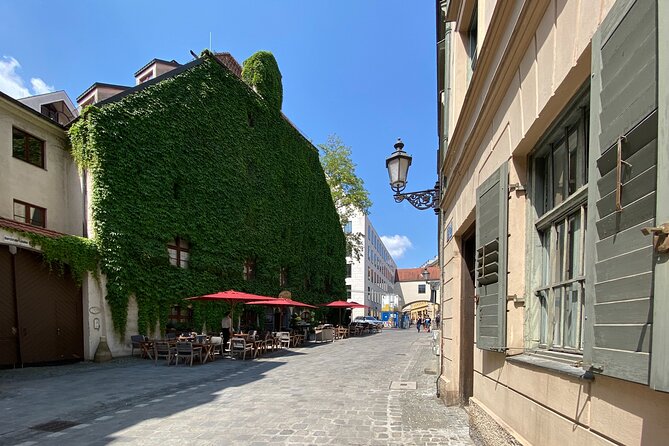
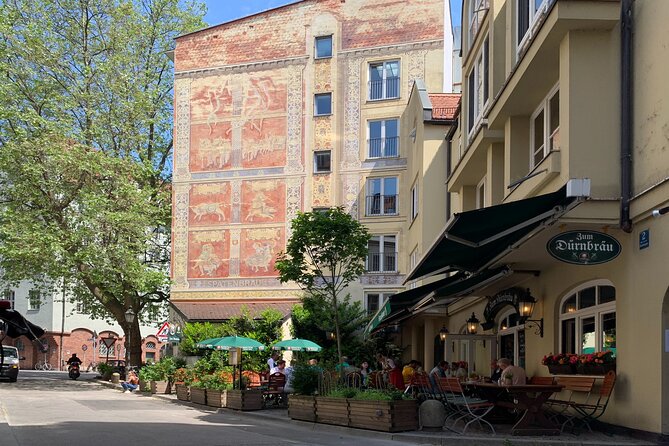
Next comes Dürnbräugasse, where you pass the oldest tavern in town. The emphasis here is on resilience—how a place stays itself through centuries. It’s the kind of detail that makes the street feel lived-in instead of museum-like.
Then you get a stop at Restaurant Pfistermühle, connected to the former royal bakery. This is where the pretzel legend becomes more than a snack story. You’ll hear the legend of the pretzel and how it links symbolically to Munich. Even if you’ve eaten pretzels your whole life, the meaning behind them can change how you see everyday traditions.
These food-and-stories moments are valuable because they break up the heavier political and architectural sites. They also help you understand why Munich treats food like culture, not just fuel.
Hofbräuhaus München: beer hall interiors, beer purity lore, and the Oktoberfest thread
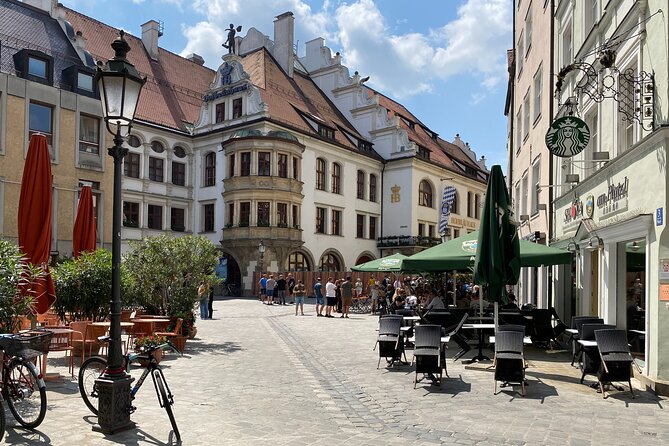
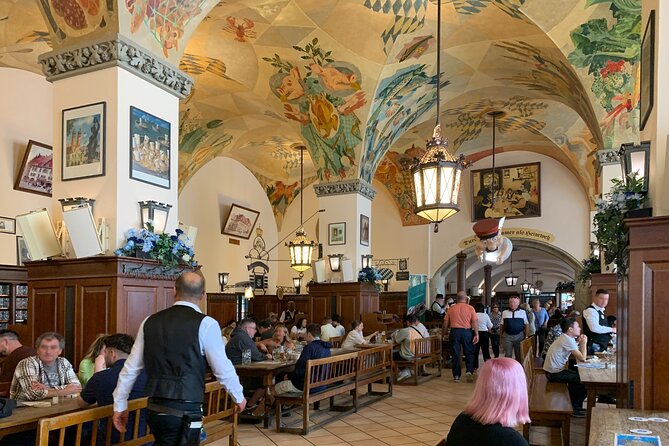
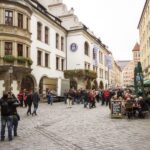
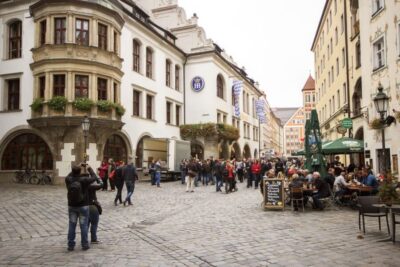
Hofbräuhaus München is the biggest crowd-pleaser on the route, and for good reason. You’ll visit the former royal brewery and head into the main hall. You’ll get to admire the interiors, notice the peculiar regular tables, and look at beer mugs of regular guests stored in special cells.
The tour doesn’t just focus on atmosphere. You’ll connect Bavarian brewing tradition to the beer purity law, and then trace how that tradition links to Oktoberfest culture. You’ll also learn the secrets of Munich beer gardens—how the city’s beer culture spreads beyond one building.
There’s also a memorable detail: meeting the beer angel. It sounds like a small line item, but it’s exactly the kind of local symbol that turns a generic attraction into a Munich moment.
One consideration: Hofbräuhaus can be busy. Your benefit as a private group is that your pace stays comfortable even when the crowds are there.
Alter Hof courtyard: Wittelsbach power, the Royal Zoo legend, and the flag colors
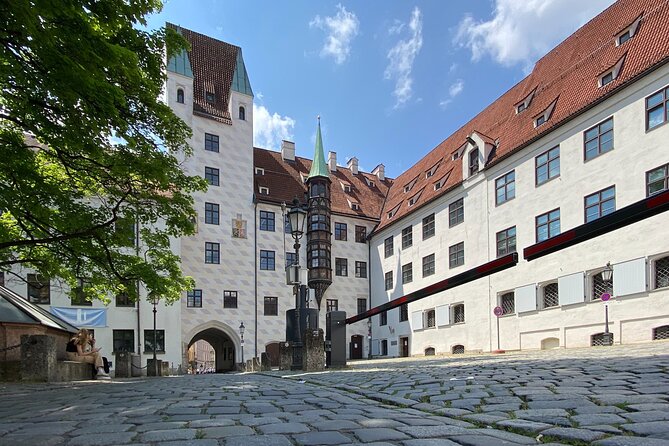
The route then shifts toward royal Munich at Alter Hof. You’ll visit the inner courtyard connected to the first residence of the Wittelsbach royal family in the city. Courtyards are underrated in guided walks, because they let you read power at human scale. You can actually picture how space worked for rulers, not just how it looks in photos.
You’ll also hear the legend of the Royal Zoo and its unexpected role in the life of the Holy Roman Emperor Louis IV. That’s a great example of how the city’s story isn’t strictly about buildings. It’s about what rulers did, displayed, and used to show authority.
You’ll also learn how Munich’s flag got its colors. That sort of civic detail is easy to miss on your own. In this tour, it feels like a quick payoff: you’ll start noticing the colors everywhere afterward.
Dallmayr and Schäfflerstraße: gourmet tradition and the pest story told through dance
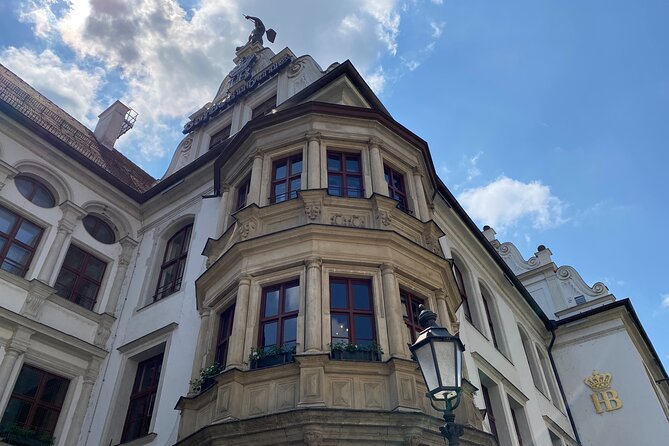
At Dallmayr Delikatessenhaus, you’ll walk past a historical gourmet store with royal tradition that later grew into one of Europe’s largest delicatessen companies. This stop is short, but it’s a smart way to add a modern flavor to the old town. You see how prestige becomes commerce.
Then you cross Schäfflerstraße, the Coopers’ Street. Here the tour brings in the legend commemorating a 16th-century pest containment celebration, including a traditional dance performed in Munich that people still connect to the city today. It’s the kind of story that makes you understand why festivals and street rituals matter: they’re memory devices.
If you’re trying to decide where to spend your time later, these stops help. They point you toward parts of the center that feel meaning-heavy, not just postcard-clean.
Frauenkirche: the footprint, the wind lore, and construction legends
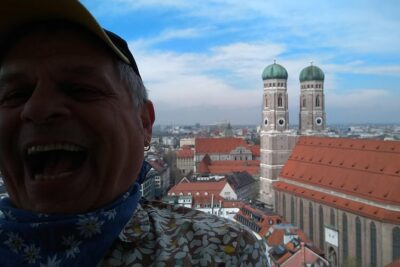
Frauenkirche (Munich’s cathedral) is where the tour slows just enough to let the place sink in. You’ll learn legends about its construction and how the interiors relate to what people expect from the outside.
Two specifics stand out in the way this stop is taught. First, you’ll sight the Devil’s footprint. Second, you’ll hear the secret of the wind around the cathedral all year long, regardless of season. Those aren’t random spooky bits. They’re part of how locals explain physical experiences and craftsmanship when they didn’t have scientific answers.
This stop is also a reminder that Munich’s center isn’t only about beer. It’s about how faith, city identity, and architecture shape each other.
Marienplatz: the Fish Fountain, Glockenspiel scenes, and local traditions you can spot
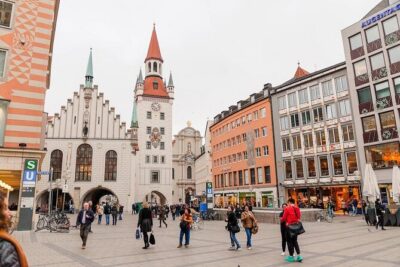
The tour ends at Marienplatz, which is the heart of the old town and a practical place to start your independent exploring. You’ll admire the Fischbrunnen (Fish fountain) and learn local traditions tied to it, including Wallet Washing and Butchers’ Jump.
You’ll also hear where Munich white sausage was invented, with the circumstances behind that claim. After that, the tour focuses on St. Mary’s Square and the major buildings facing it: the New Town Hall and Old Town Hall.
Then comes the Glockenspiel. You’ll understand the mechanical clock and the two momentous scenes it reenacts to various tunes. This is the moment when you stop seeing it as a tourist gadget and start seeing it as public storytelling.
When you finish here, you can keep using the guide’s tips in a real way: pick a nearby coffee or beer, find a museum you actually want, or plan a return to view the square again at the right time.
What the tour feels like in real life: pace, visuals, and comfort
One reason this tour has a perfect score is that it doesn’t treat people like a stopwatch. Victoria keeps groups engaged and adapts when necessary. If you’re traveling with a baby, or you have grandparents in your party, you’ll still feel included because the pace stays comfortable.
You’ll also benefit from her presentation style. Multiple stops get supported with pictures, maps, and visuals on her iPad. That helps you connect the street you’re standing on to the bigger story you’re hearing.
Comfort details matter on a 2-hour walk. In real tours, you need a bathroom break. Victoria builds in a midway stop and makes sure you’re not rushing off-center at the end. And if you want an easy keepsake, she can take a group photo.
Weather can be unpredictable in Munich. This isn’t a long rainy-day slog. It’s short enough that even if it’s wet, you’ll likely stay dry for most of it while still getting the key sights.
Price and value: when $157.28 per group is a smart move
At $157.28 per group (up to 6), the value depends on how many people you bring. If you have a full group, it’s about $26 per person for a private, guided walk that covers multiple landmarks with entrance fees handled.
That matters because you’re not only paying for access. You’re paying for interpretation. In Munich, the best parts of the experience are often the small connections: how a building changes meaning, why a tradition exists, and what you’re meant to notice when you stand in front of something famous.
This also saves time. If you have limited days, you can use the tour to get your bearings fast and then spend the rest of your time choosing what you actually want to revisit on your own.
Who should book this Munich Old Town tour
I’d book it if:
- you want a first-pass orientation that still feels meaningful
- you like legends and local explanations, not just dates
- you’re traveling with a mixed-age group and want the pace adjusted
I’d think twice if:
- you prefer long inside visits or detailed museum time
- you want lots of free roaming without structure
For families, couples, solo travelers who like conversation, and groups up to 6, it’s a very practical fit. And because you finish at Marienplatz, you get a natural launch point for the rest of your day.
Should you book this tour?
If you want Munich to make sense in a short amount of time, I think this is a solid yes. The biggest reason is the combination of storytelling with real-world guidance—how the city worked, why it looked the way it did, and where to go next when you’re done.
If you’re the kind of traveler who likes to understand what you’re seeing and then immediately use it, you’ll likely feel glad you booked. If you only want casual walking with minimal context, you might find it a bit story-heavy. But for most people aiming to fall in love with Munich, this is a strong place to start.
FAQ
How long is the private walking tour?
The tour runs for about 2 hours.
What is the group size limit?
It’s a private tour for groups of up to 6 people.
Where does the tour start and end?
It starts at Isar Gate (Tal 50, 80331 München) and ends at Marienplatz.
Is the tour offered in English?
Yes, it’s offered in English.
Is there a map provided?
Yes, you receive a digital map of the tour itinerary.
Are entrance fees included?
Entrance fees for the tour stops are included as part of the experience.
Does the tour include food or drinks?
No. Food and drinks are not included.
What’s the meeting point like?
You meet under the central arch of Isar Gate.
Is the guide able to support different ages?
Based on the tour’s format and how it’s run, it can work well for mixed groups, and the pace is kept comfortable.
What should I do after the tour ends at Marienplatz?
Use the guide’s local tips to keep exploring near Marienplatz, including where to eat, enjoy coffee, or have a beer.
More Altstadt and Marienplatz Walks



Just added to the Munich Explorer notebook

Old Town & Marienplatz Walks, compared.
 ★ 4.6Third Reich & WWII Walking TourFrom $316,181 reviews
 ★ 4.5Third Reich Walking Tour MunichFrom $454,291 reviews
 ★ 4.7Old Town & Viktualienmarkt City Walk in GermanFrom $232,304 reviews
 ★ 4.7Night Watchman Walking TourFrom $5302,092 reviews
 ★ 5.0Munich Ghosts and Spirits Evening Walking TourFrom $601,900 reviews
 ★ 4.5Munich Old Town Walking TourFrom $271,287 reviews
 ★ 4.6Spooky Tour of Old Town in GermanFrom $261,112 reviews
 ★ 4.7Walking Tour Old Town and ViktualienmarktFrom $282839 reviews
Browse the lists this tour appears in