
Reviewed · ENGLISH GARDEN & EISBACH SURFING
Private Munich Rickshaw City Tour and English Garden
A rickshaw turns Munich into a moving postcard. You get a fast, comfortable loop through Marienplatz and the royal-center streets, then you slow down in the English Garden for the Eisbach and classic park scenery. I like that it keeps things efficient without skipping the big names, and I also like the personal touch—guides such as Andy and Andre have a knack for adapting to the group and handling cold weather with blankets. One possible drawback: this is outdoors and weather-dependent, so in truly bad conditions you may have to shift dates.
If you’re short on time, this format is a smart shortcut. The tour runs about 1 hour 30 minutes, stays in central areas, and it’s set up as a private experience for just your group (up to 2 per booking), so you’re not stuck listening to a crowd. Since it’s offered in English with a mobile ticket, it’s easy to organize and easy to show up for—just be ready for the fact you’ll be outside most of the ride.
Here’s the bottom line: you trade a bit of freedom to linger for a smooth “best-of Munich” overview, delivered by a guide who brings local detail without turning the whole thing into a lecture. If you want one relaxed morning or afternoon that hits major sights plus the English Garden, this is a very reasonable way to do it.
In This Review
- Key points at a glance
- Why this 90-minute private rickshaw tour feels like Munich’s best cheat code
- Getting oriented fast: the Marienplatz start and the flow into Old Town
- English Garden time: the Eisbach, Chinese Tower, and Kleinhesseloher See
- Max-Joseph-Platz and the “northernmost Italy” feel
- Hofbräuhaus at Platzl: history you can still smell
- Viktualienmarkt: market chaos, in the best way
- Residenz München and the court-building scale you can’t grasp from photos
- Odeonsplatz and the royal-ceremonial street web
- Hofgarten and the Diana Temple: a royal garden palate cleanser
- Bavaria’s government buildings: why it matters to your city map
- Rickshaw comfort, timing, and why the guide can make or break it
- Price and value: what you’re really paying for with a private rickshaw
- Who should book this, and who should skip it
- Should you book this private Munich rickshaw tour?
- FAQ
- FAQ
- How long is the private rickshaw tour?
- Where does the tour start?
- What language is the tour offered in?
- What is the price and group size?
- Is this a private tour?
- What stops are included?
- Do I need good weather for the tour?
- Is a mobile ticket provided?
- Are service animals allowed?
Key points at a glance
- Private rickshaw time for up to 2: less stress than joining a big group ride.
- English Garden focus: time for the Eisbach surfer wave and the park’s standout landmarks.
- Old Town highlights in one loop: Marienplatz, major squares, and the royal axis connections.
- Royal architecture stop at Residenz: a quick look at the scale of Munich’s court complex.
- Market and beer-house stops: Viktualienmarkt and Hofbräuhaus give you the local rhythm.
- Cold-weather comfort: blankets and warm items have made a noticeable difference on chilly days.
More pedicab spins through the city centre
- Munich: City Highlights Rickshaw Tour★ 4.9 · 150 reviews
- Private Munich Rickshaw City Tour and English Garden★ 5.0 · 49 reviews
- Private and full rickshaw tour in the English Garden★ 4.5 · 10 reviews
- Exploring Munich by Pedicab: Premium Two Hour Tour★ 5.0 · 10 reviews
Why this 90-minute private rickshaw tour feels like Munich’s best cheat code
Munich can be surprisingly big when you’re walking. This tour solves that with a simple idea: sit back, roll through the center, and let your guide connect the dots while you stay warm and upright. The route is built around the city’s “greatest hits” neighborhoods—old town squares, royal streets, and the park that locals treat like a second living room.
I especially like the balance: it’s not just sightseeing from one monument to the next. You get street-level views of the old city feel, then you’re actually in the English Garden long enough to notice why people love it. And because it’s private for your group, you can ask questions that matter to you—food, architecture, how Munich works day-to-day—without waiting for an opening in a loud group setting.
One thing to keep in mind: you’re covering a lot of territory in 1.5 hours, so it moves at a pleasant, guided pace rather than a “stop and wander forever” pace. If you’re the type who wants to poke into every side street, you’ll likely want an extra afternoon later.
Getting oriented fast: the Marienplatz start and the flow into Old Town
You’ll start at Marienplatz, Munich’s central square where medieval streets meet modern city life. This is a strong opening because Marienplatz tells you how the city is laid out. From there, the ride nudges you toward the main axes and nearby “power points” that shape Munich’s look and feel.
Marienplatz also sets expectations for the whole tour: you’re going to see architecture in layers—older buildings that still matter, and newer structures that keep the city moving. Even if you’ve already looked at photos, being there in person helps. The guide’s job is to turn your quick glance into a mental map: what you’re looking at, why it’s positioned there, and what to remember later when you explore on your own.
After Marienplatz, the route naturally trends toward the city’s grand streets and squares. It’s a “north to south” kind of feeling: you sense the change from everyday central bustle to the more ceremonial, royal-style parts of town.
English Garden time: the Eisbach, Chinese Tower, and Kleinhesseloher See
The heart of the experience is the English Garden stop, around 30 minutes. This matters because it’s not a token visit. You’re there long enough to get a real sense of the scale and the vibe.
Key sights you should expect to see include:
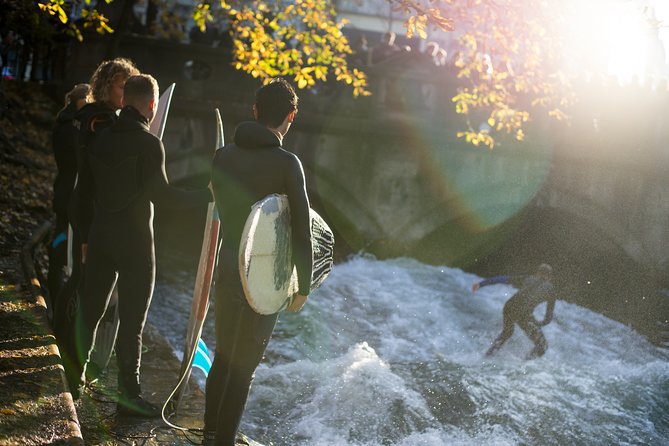
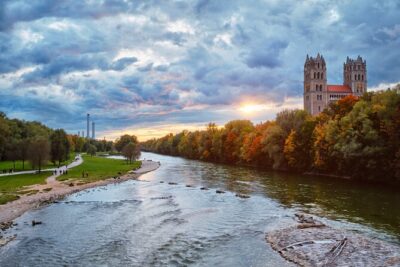
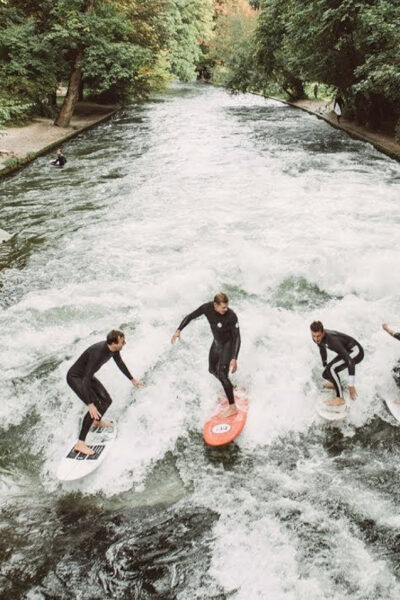
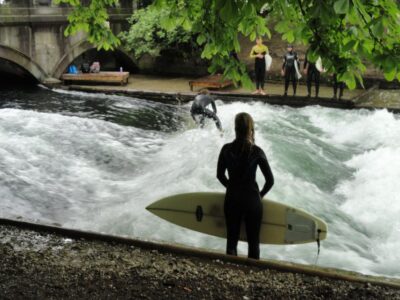
- The Eisbach and the famous surfer wave. This is one of those Munich things that sounds odd until you see it. Even if you don’t care about surfing, the wave is a perfect example of how locals treat the park like a living space, not a museum.
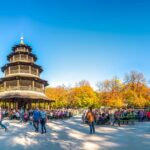
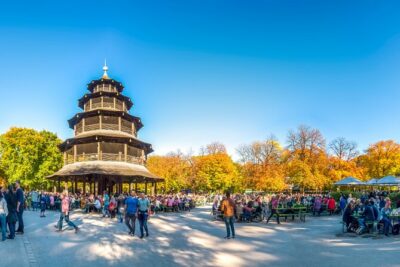
- The Chinese Tower, a recognizable landmark that gives the park an international flavor.
- Kleinhesseloher See, which adds a calmer, reflective counterpoint to the more energetic river scenes.
From a logistics point of view, the big win is that a rickshaw helps you see the park highlights with far less walking than you’d likely do on your own in a short timeframe. If your legs get tired, or you want to conserve energy for later (beer hall, market strolls, a museum), this park block is a smart use of time.
Also: it can get chilly, even when Munich looks sunny. One of the most repeated fixes you’ll hear about from the guide team is comfort gear—blankets and hot items—so you’re not forced to end the fun early.
More open-top loops around the sights
- Munich Hop-On Hop-Off Tour: 1-Day or 2-Day Ticket
★ 4.3 · 4,161 reviews - Munich: Old Town & Viktualienmarkt City Walk in German
★ 4.7 · 2,304 reviews - Munich: City Bus Tour & FC Bayern Munich Allianz Arena Tour
★ 4.5 · 2,071 reviews
Max-Joseph-Platz and the “northernmost Italy” feel
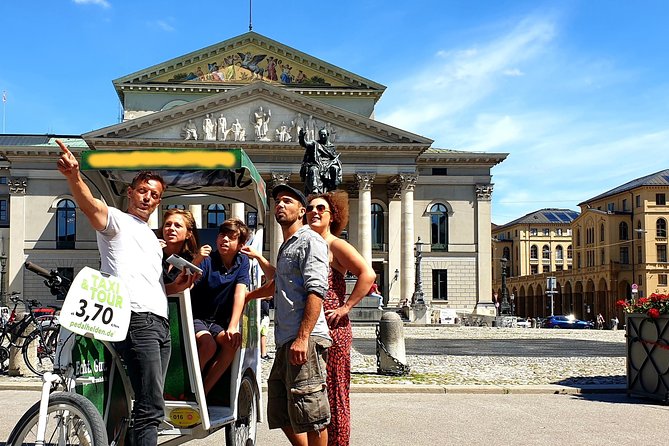
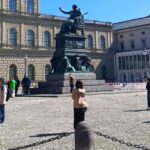
Next you’ll roll into the area around Max-Joseph-Platz, where Munich’s elegance shows up fast. This stop is short, but it’s designed to hit what people love to photograph: the formal streets and the sense of a carefully planned city center.
Look out for:
- Maximiliansstrasse
- The National Theater
- The royal buildings in the surrounding axis
This part of Munich has that “southern flair” vibe that locals describe with the northernmost Italy nickname. It’s the kind of place where the streets feel staged—wide, formal, and perfect for imagining how ceremonial life looked in earlier centuries.
In practice, this stop is less about stopping long and more about giving you context. After this, you’ll understand why the later squares feel connected, why the city’s major buildings sit where they do, and how the tour’s route keeps making sense.
Hofbräuhaus at Platzl: history you can still smell
You’ll get a quick stop at Staatliches Hofbräuhaus on Platzl, where people have been coming for beer since 1589. That’s the headline fact, but the real reason this stop works is atmosphere. Platzl is one of those “something is always happening” areas, and seeing it from the rickshaw gives you a good sense of where energy gathers.
This is also a useful stop even if you don’t plan to drink much. It anchors the tour in Munich’s everyday culture. You’re not only looking at monuments—you’re seeing how the city’s social life maps onto its geography.
If you like to plan your day around food and drinks, you’ll probably appreciate how efficient this is. You can decide later whether you want to linger at a beer hall with your own time, but you’ll arrive already oriented.
Viktualienmarkt: market chaos, in the best way
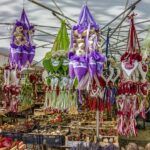
Then you’ll pass through Viktualienmarkt, one of Munich’s signature places to eat, browse, and people-watch. This stop is brief, but it’s packed with cues:
- The famous butcher line
- The beer garden vibe (even if you don’t stop for a table)
- A wide range of stalls, including regional and exotic options—there are well over 100 sellers.
This is a stop that works even if you’re not a big market person. Markets teach you what a city values. In Munich’s case, it’s ingredients and traditions, plus the casual pleasure of sampling things without turning the whole afternoon into a formal event.
A practical tip: if you’re thinking about snacks later, Viktualienmarkt is a good time to spot what looks best. You won’t have time for a full shopping spree here, but you can gather ideas for what to try when you return.
Residenz München and the court-building scale you can’t grasp from photos
One of the most interesting parts of the ride is the view toward Residenz München, described as the largest Renaissance building found in German cities. Even if you don’t enter, seeing it from the outside helps. This complex is huge and made of multiple layers, which is hard to understand from a single photo.
What you should keep in mind for this stop:
- Nine inner courtyards
- The Cuvilliertheater, famously visited by Napoleon
- The Brunnenhof and the Wittelsbacher Brunnen
Residenz is the kind of place where a guided visit can take hours if you go deep. The rickshaw stop isn’t that. It’s more like a “set your expectations” checkpoint. You’ll leave knowing what kind of scale you’re looking at, and if you want the full story later, you’ll know where to direct your time.
Odeonsplatz and the royal-ceremonial street web
You’ll spend time around Odeonsplatz, a major square with intense historical weight. This stop connects multiple nearby landmarks, including:
- Ludwigstrasse
- The Theatine Church
- Feldherrnhalle
- Brienner Strasse
Odeonsplatz is also the kind of place where small details matter. One standout you can learn from this stop is that Empress Elisabeth (Sisi) was born here. That’s the sort of fact that gives you a human hook for a square that otherwise feels like stone and symmetry.
The value of including Odeonsplatz is that it helps you understand Munich’s “axis logic.” Buildings aren’t placed randomly. They’re arranged so the city feels ceremonial when you move through it. The rickshaw helps you take that in without tiring out.
Hofgarten and the Diana Temple: a royal garden palate cleanser
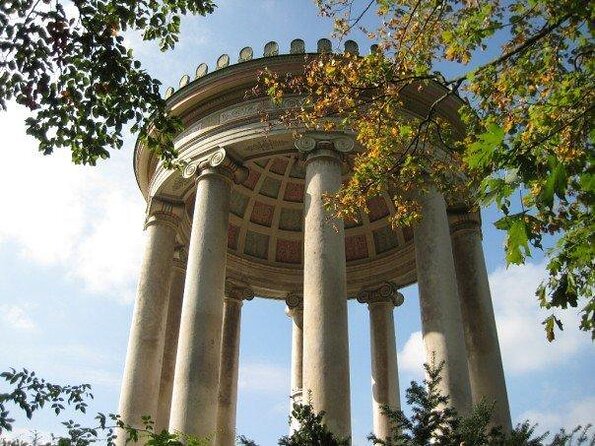
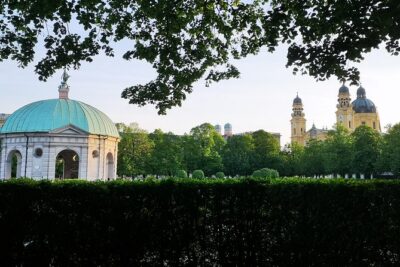
After the heavy squares, you’ll get a calmer stop at Hofgarten, where a royal garden has existed next to the residence since the 16th century. The ride brings you to the Diana temple inside the garden complex, with fountains, flowers, and hedges.
This is a good palate cleanser. It breaks up the density of architecture stops with something that feels lighter and more relaxed. Even if you don’t linger long, you’ll pick up the transition: Munich isn’t only grand buildings. It also designs spaces for rest and strolling.
If you like gardens, you’ll probably walk away thinking about adding time for a return visit—just with more daylight and time to actually enjoy the paths.
Bavaria’s government buildings: why it matters to your city map
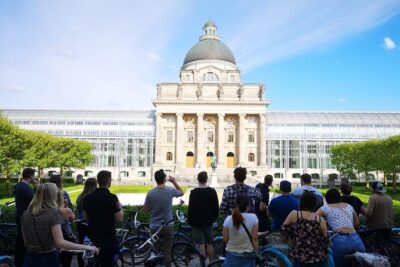
You’ll also see Bayerische Staatskanzlei, the representative building of the Bavarian government. It used to be the Army Museum, and the location sits between the Hofgarten area and other key zones like Prinzregentenstrasse.
This part isn’t about turning you into a political history expert. It’s about helping you recognize how the city’s important institutions sit inside the same central fabric as museums, theaters, and garden space. Once you’ve seen where things are, your self-guided exploration later feels easier.
Rickshaw comfort, timing, and why the guide can make or break it
A rickshaw tour stands or falls on comfort. The good news is that this experience has a track record of keeping people warm and supported. On cold days, guides have provided blankets and even hot water bottles, which is a big deal when you’re sitting still outdoors.
Guide style is another big difference-maker. Names you may hear include Andy, Andre, Andreas, and Michael. The common thread is that they don’t just list sights. They explain what you’re seeing in a way that makes you care, then they adjust to your pace. Some groups even ask for small custom touches—like adding a little extra time toward the park focus—so the tour feels more like your day than a fixed script.
Timing is tight but not rushed. Your stops are short by design, which means you get variety instead of one long “watch a single building” session. The tradeoff is you may want to return to one or two places after, especially if you love architecture.
Price and value: what you’re really paying for with a private rickshaw
At $130.96 per group (up to 2) for about 1 hour 30 minutes, this isn’t a bargain in the budget sense. But it can be a strong value depending on your priorities.
Here’s how I think about the price:
- You’re paying for private routing through the center. That saves time versus piecing together several transit segments and long walks.
- You’re paying for comfort and local guidance. Even a few extra minutes spent understanding what you’re looking at can turn photos into memories that mean something.
- You’re paying for English Garden access and efficiency. The park is the hardest part to cover quickly on foot without feeling like you’re sprinting between highlights.
If you’re traveling as a couple or a small family group, the cost per person often starts to look more reasonable. And if you have mobility limitations, the rickshaw format can be a practical advantage because you’re not spending the whole day on your feet—just sitting and viewing.
The one price caveat: if you’re traveling solo and you only need a couple of stops, a shared walking tour might cost less. But if you want the park plus multiple central squares in one shot, this format earns its keep.
Who should book this, and who should skip it
This tour is a great fit if:
- You want a first-pass orientation to Munich early in your trip.
- You’re short on time but still want the real highlights: central squares, royal streets, beer hall culture, a major market, and the English Garden.
- You prefer sitting in comfort instead of walking the whole day.
- You’d like a guide to explain what matters while you watch the city roll by.
You might skip it if:
- You want to spend lots of time inside buildings. This is mostly an exterior and viewpoint experience.
- You’re traveling in weather that isn’t cooperative. The experience needs good weather, and the plan may shift.
Should you book this private Munich rickshaw tour?
I’d book it if your goal is a relaxed, guided overview that makes Munich feel easy to navigate afterward. The combination of Marienplatz, major ceremonial squares, Residenz München scale, Viktualienmarkt culture, and a real chunk of the English Garden is a smart use of 90 minutes. Add the comfort-first approach—especially when it’s cold—and you get a tour that feels practical, not just scenic.
If you’re deciding between this and a walking day, pick the rickshaw if you want fewer sore legs and more highlights per hour. Then plan to return later for any one place you love most, with your new mental map in hand.
FAQ
FAQ
How long is the private rickshaw tour?
It’s about 1 hour 30 minutes.
Where does the tour start?
The meeting point is Marienplatz, 80331 München-Altstadt-Lehel, Germany.
What language is the tour offered in?
The tour is offered in English.
What is the price and group size?
The price is $130.96 per group, and the group size is up to 2.
Is this a private tour?
Yes. It’s private, so only your group participates.
What stops are included?
The tour includes stops at Marienplatz, the English Garden, Max-Joseph-Platz, Staatliches Hofbräuhaus, Viktualienmarkt, Residenz München, Odeonsplatz, Hofgarten, and Bayerische Staatskanzlei.
Do I need good weather for the tour?
Yes. The experience requires good weather, and if it’s canceled due to poor weather you’ll be offered a different date or a full refund.
Is a mobile ticket provided?
Yes, the tour uses a mobile ticket.
Are service animals allowed?
Yes, service animals are allowed.
More of the English Garden and Eisbach

More Hop-On Hop-Off Loops in Munich

More Pedicab Rides in Munich

Just added to the Munich Explorer notebook
English Garden & Eisbach Surfing, compared.
 ★ 5.0Classic Mike’s Bike Tour daily @ 11.30 incl Beer Garden & SurfersFrom $421,246 reviews
 ★ 5.0Mini Classic Bike Tour @ 4pm incl. Beer Garden & Surfers 2,5 hrsFrom $45251 reviews
 ★ 4.0City Bike and English Garden TourFrom $4614 reviews
 ★ 4.5Private and full rickshaw tour in the English GardenFrom $15510 reviews
 ★ 5.0Eisbachwelle River Surfing ExperienceFrom $1709 reviews
 ★ 5.0Munich private Car & Walking Tour incl. BMW World & River SurfersFrom $6828 reviews
 ★ 3.0Surf Experience In Munich Eisbach River Wave -GermanyFrom $1456 reviews
 ★ 5.0Munich Surf Experience Surfing In Munich Eisbach River WaveFrom $1314 reviews
Browse the lists this tour appears in