
Reviewed · CYCLING TOURS
Best of Munich Electric Bike Tour
Munich hits different when you ride. This electric bike tour strings together major sights with clear, guided stops so you can keep moving without getting wrecked. I love the e-bike assistance for saving your legs, and I love how the guide’s pacing makes it feel stress-free instead of you chasing directions. One thing to watch: the group can be up to 20 and may mix e-bikes with regular bikes, so road behavior and your own confidence matter.
The route focuses on architecture and history, then lands in the places you actually want to linger. You’ll get quick hits at squares like Königsplatz and Odeonsplatz, plus park time in the English Garden and a classic beer garden moment at the Chinese Tower area. If you’re hoping for long museum stays, plan your expectations: many stops are brief, built for orientation and context rather than deep ticketed time.
In This Review
- Key things that make this tour worth your time
- Munich by e-bike: the simple reason it feels easier
- Getting oriented at Karlsplatz before the city moves fast
- Maxvorstadt squares and the art museum zone you can’t miss
- Alte Pinakothek and Pinakothek der Moderne: quick hits with real context
- Siegestor, Odeonsplatz, and the Residenz: where monuments keep score
- Hofgarten and the modern government layer above older bones
- The English Garden stretch and the Chinese Tower beer garden moment
- Eisbachwelle: the standing-wave stop that feels like a local secret
- Friedensengel and Maximilianeum: peace, viewpoints, and a parliament building
- Deutsches Museum, Viktualienmarkt, and Ohel Jakob: ending with culture you can eat and see
- What the best guides do (and why it matters for your day)
- Practical expectations: weather, bike effort, and how long you’ll actually “do”
- Beer planning: what’s included and what costs extra
- Should you book this Munich electric bike tour?
- FAQ
- How long is the electric bike tour?
- What is the price per person?
- What language is the tour offered in?
- What’s included in the tour price?
- Do I pay for food or drinks on the tour?
- Are admission fees required at the stops?
- How big is the group?
- Where does the tour start and end?
Key things that make this tour worth your time

- Electric bike help when the day gets cold or long, with helmets provided
- A tightly planned loop that connects Maxvorstadt, the old royal core, and the Isar-side parks
- Architecture that tells a story, from Neo-Classicist fountains to war memorials and palace power
- Beer culture built in, including the option for traditional German beer at an extra-cost stop and a Hofbräu beer garden stop at the Chinese Tower area
- Guides who steer and explain, with many praised for fun delivery and keeping the group together
- Lots of major sights for the time, hitting art landmarks and major squares without day-long wandering
More saddle time around Munich
- Classic Mike’s Bike Tour daily @ 11.30 incl Beer Garden & Surfers★ 5.0 · 1,246 reviews
- Neuschwanstein Castle by Bus Incl. Bike Ride or Hohenschwangau★ 5.0 · 607 reviews
- Munich: Guided City Tour by Bike with Beer Garden Stop★ 4.7 · 604 reviews
- Munich Small-Group Bike Tour★ 4.5 · 510 reviews
Munich by e-bike: the simple reason it feels easier
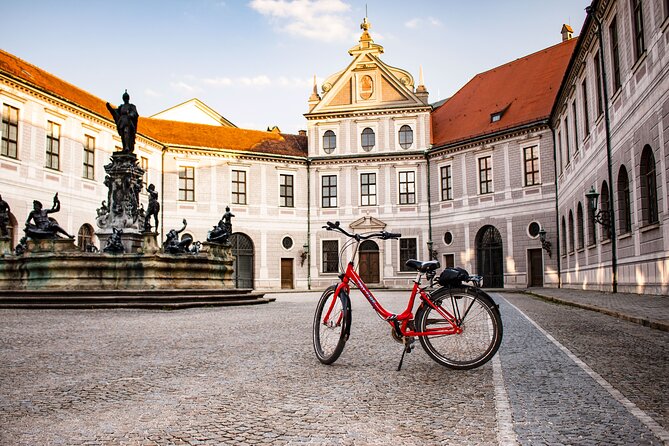
This tour is built for people who want the big sights, but don’t want the tired-foot tax. The e-bike and helmet are included, and the point is practical: you can ride through the city’s museum and landmark zones while staying comfortable enough to absorb what you’re seeing.
The price—$71.90 per person for about four hours—also makes more sense when you compare it to paying for transport, then paying for guide time on top. Here, you’re paying for a guide-led route plus the bike setup, while food and drinks stay on you.
Getting oriented at Karlsplatz before the city moves fast
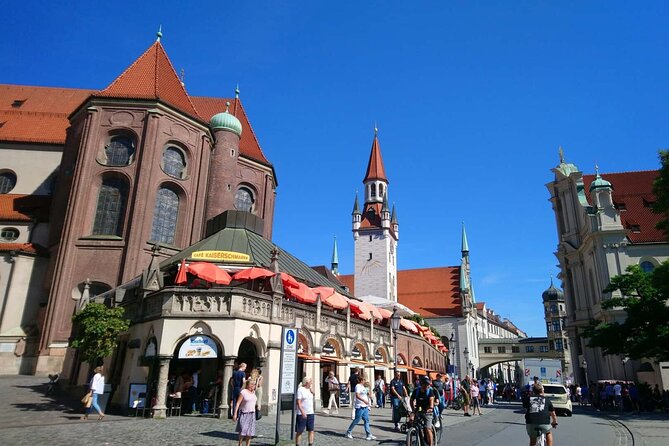
You start at Karlsplatz 4 (Karlsplatz), and you end back there. That matters more than you’d think: you’re not scrambling for a meeting point in the middle of your day, and your ride naturally loops back for an easy finish.
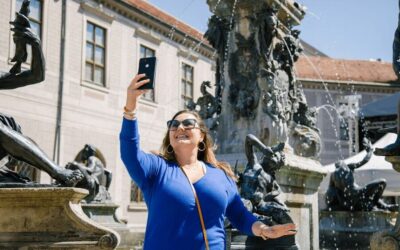
From the start, the tour rhythm is: ride, stop for a key landmark, quick explanation, then move again. You’ll do short stops at places like the Wittelsbacherbrunnen—an impressive monumental fountain on the northwestern edge of Munich’s city center—created between 1893 and 1895 by sculptor Adolf von Hildebrand in a Neo-Classicist style. It’s also an allegory for the primal forces of water, which is exactly the kind of detail a good guide pulls into focus.
Maxvorstadt squares and the art museum zone you can’t miss
After the fountain stop, the tour heads into a part of Munich that’s heavy on design and museums.
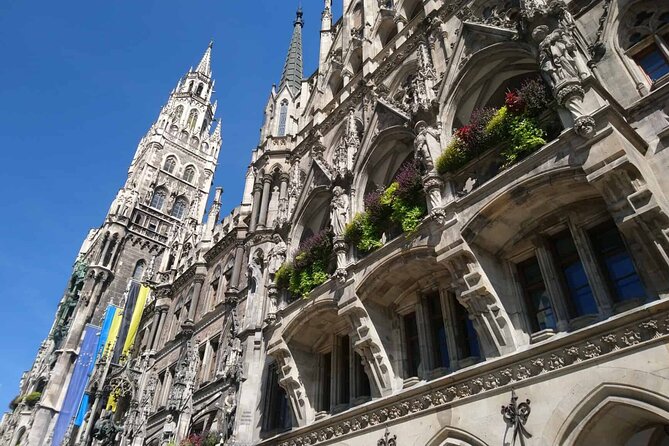
Karolinenplatz is the first key square you hit. It ties into Munich’s relationship with France in the early 19th century, and it’s named for Queen Caroline of Bavaria. This is one of those stops that helps you read the city instead of just photographing it.
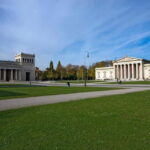
Next is Königsplatz, designed in European Neoclassicism with the Propyläen Gate, plus the Glyptothek and Staatliche Antikensammlungen across from it. The area around it is the Kunstareal, Munich’s gallery and museum quarter. Even if you’re not doing full museum visits, this stop helps you understand why Munich’s art scene isn’t random—it’s planned and clustered.
Then comes a stop that’s harder to look at, but important: the Führer Building. Built between 1933 and 1937 during the Nazi period and used extensively by Adolf Hitler, it still stands today and now houses the University of Music and Performing Arts Munich. Your guide’s job here is to give you context without turning the ride into a lecture. It’s a reminder that cities carry layers, including uncomfortable ones.
More e-bike loops around Munich
- Best of Munich Electric Bike Tour
★ 5.0 · 38 reviews - Best of Munich Electric Bike Tour
★ 4.7 · 23 reviews - Superior E-Bike Tour incl. 3rd Reich Sites & a beer Garden Stop
★ 5.0 · 8 reviews
Alte Pinakothek and Pinakothek der Moderne: quick hits with real context
You’ll stop near two major art institutions in Munich’s museum quarter.
At Alte Pinakothek (Old Pinakothek), you’re in the orbit of one of the oldest galleries in the world, known for Old Master paintings. Even with a short stop, it’s worth being there because it anchors the city’s long-running taste for classic art.
Then you’ll roll to Pinakothek der Moderne, which brings together multiple collections in one building—modern and contemporary art, works on paper, design and applied arts, plus an architecture museum component. This is a great stop for anyone who’s noticed Munich isn’t just about castles. It’s also a city of institutions that treat design and modern art as serious public culture.
Because many stops are brief, treat these as orientation stops. You’ll leave with names and locations you can target later if a particular museum actually grabs you.
Siegestor, Odeonsplatz, and the Residenz: where monuments keep score
From the museum quarter, the vibe shifts toward the grand civic and royal axis.
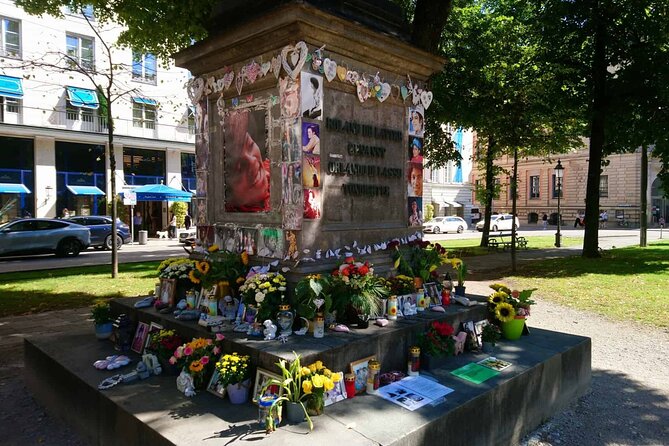
Siegestor (Victory Gate) is a three-arched memorial arch crowned with a statue of Bavaria holding a lion-quadriga. Historically it was dedicated to Bavarian military glory, but after WWII restoration it now points to peace. That change matters. Munich doesn’t just preserve monuments—it reframes them.
Next, Odeonsplatz is a key square developed in the early 19th century by Leo von Klenze. It’s tied to the former Odeon concert hall, and the name also refers to the Residenz forecourt area near Theatine Church, lined toward the Feldherrnhalle. Importantly, Odeonsplatz was the scene of a fatal gun battle ending the 1923 Beer Hall Putsch. This is the kind of stop where you’ll understand why these spaces feel heavy even when they’re visually open.
Then you get to the Residenz, the former royal palace of the Wittelsbach monarchs. It’s described as the largest city palace in Germany, and today it’s open for architecture, room decorations, and former royal collection displays. The tour doesn’t turn this into a long palace marathon, but the quick stop is still useful: it gives you a “map in your head” before you decide whether you want to go inside.
Hofgarten and the modern government layer above older bones
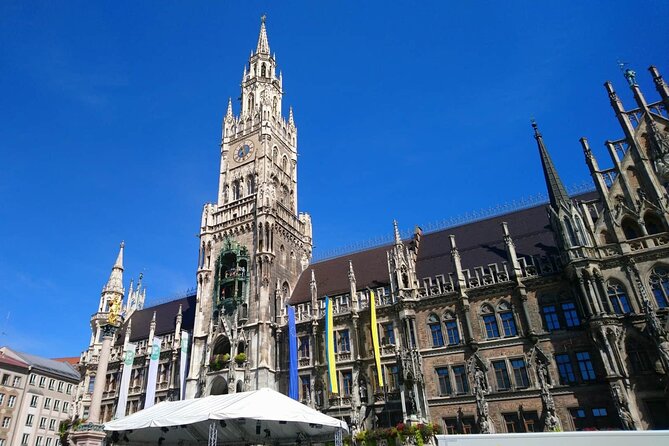
Between the Residenz and the Englischer Garten sits Hofgarten, a garden built in 1613–1617 by Maximilian I in an Italian Renaissance style. In the center is a pavilion for the goddess Diana built in 1615 by Heinrich Schön the elder. If you like classical symmetry, this is a calm counterpoint after the monumental buildings.
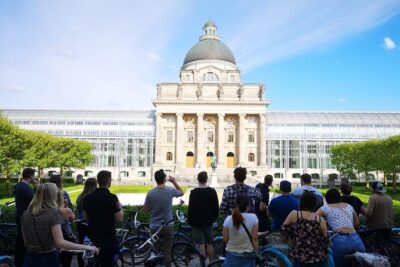
A bit later you’ll see Bayerische Staatskanzlei, the building that houses the Bavarian chancellery offices. It was built from 1989 to 1993 around the central dome of a former Bavarian Army Museum (built in 1905), which itself stood on a site linked to the Hofgartenkaserne barracks and was demolished in World War II. This stop is a good example of how Munich layers old and new—sometimes literally in the same footprint.
The English Garden stretch and the Chinese Tower beer garden moment
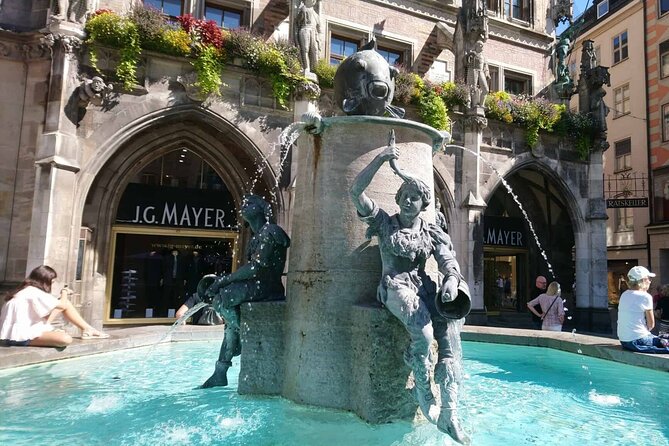
Now you hit one of the tour’s strongest “hang-out” sections: English Garden time. It’s huge—3.7 km² (370 hectares / 910 acres)—and that scale changes how you experience the city. Here, the ride feels less like you’re sprinting between landmarks and more like you’re borrowing space from the landscape.
After that, the tour pauses at Biergarten am Chinesischen Turm. It’s an outdoor beer garden with typical shared tables under trees, and beer gardens themselves originated in Bavaria in the 19th century. This specific spot is run by Antje Schneider, with 7,000 seating places, and it’s the second largest beer garden in Munich after Hirschgarten. It sells Hofbräu beer, and this is the kind of stop where your guide can point out the local customs you’d miss if you just showed up on your own.
One more detail to keep in mind: food and drinks aren’t included. So budget for beer or a snack if you want to make the stop a real break rather than just a photo moment.
Eisbachwelle: the standing-wave stop that feels like a local secret
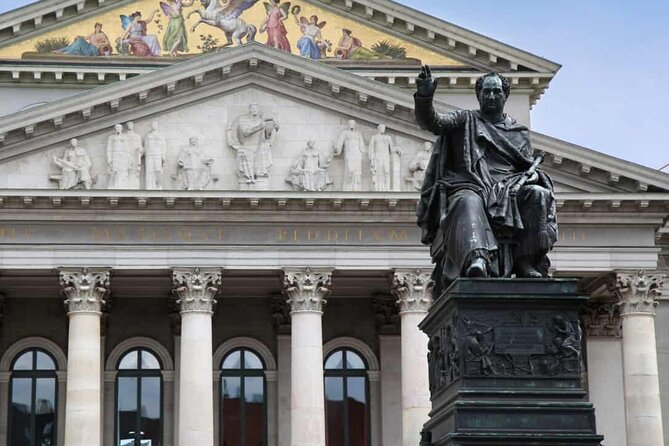
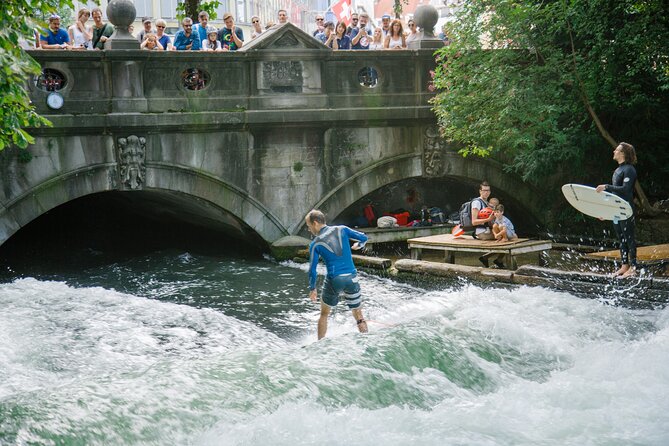
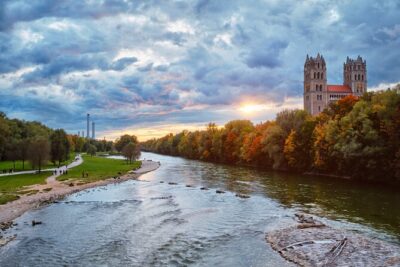
Near the Haus der Kunst area, you’ll stop at Eisbachwelle, a standing wave on the river Isar about one meter high, famous as a river surfing spot. The water is cold and shallow—sometimes around 40 cm deep—so it’s only suitable for experienced surfers.
Even if you’re not watching surfers all that long, it’s a memorable stop because it reframes the English Garden as something active. Munich isn’t just historic stone and formal gardens. It’s also people using the river edge every day.
Friedensengel and Maximilianeum: peace, viewpoints, and a parliament building
As you head toward the eastern end of Maximilian Park, you’ll reach Friedensengel (Angel of Peace), a point of view that sits next to the Isar and includes a fountain setup with a dolphin waterspout plus four smaller waterspouts. There’s an observation deck reached by stairs, topped by a 38-meter Corinthian-style column with a six-meter statue of the Angel of Peace, described as a replica of the Nike of Paeonius.
Then you’ll roll toward the Maximilianeum. It’s a palatial building originally designed as a home for a gifted students’ foundation, but since 1949 it has housed the Bavarian State Parliament. This stop ties the tour’s theme together: Munich’s identity comes from power, culture, and public institutions—not just scenery.
Deutsches Museum, Viktualienmarkt, and Ohel Jakob: ending with culture you can eat and see
You finish the ride with stops that feel very current, in a good way.
At Deutsches Museum, you’re at the world’s largest museum of science and technology, with about 125,000 exhibited objects across 50 fields, drawing roughly 1.5 million visitors per year. Your stop is brief, but it’s a strong “Munich isn’t only art” message.
Next, the tour hits Viktualienmarkt, which evolved from an original farmers’ market into a gourmet market. It covers an area with around 140 stalls and shops, with items like flowers, exotic fruit, spices, cheese, fish, juices, and more. Even if you don’t buy much, this stop helps you plan the kind of meals you’ll enjoy after the tour.
Finally, there’s Ohel Jakob Synagogue, the new main synagogue for Munich’s Jewish community. Built between 2004 and 2006, it was inaugurated on 9 November 2006, on the 68th anniversary of Kristallnacht. It’s a significant closing stop because it brings modern Munich culture into view, not just historic monarchs and wartime stories.
What the best guides do (and why it matters for your day)
The tour’s quality rises or falls on the guide, and this one tends to deliver. Names that come up often include Rob, Canaan, Karl, Susanna, Suzanne, Mark, and Dan. The common thread: these guides explain what you’re looking at in a way that sticks, and they pay attention to the group so you stay together and safe.
You’ll also see that the pacing is a big deal. Several guides are praised for good timing—short stops where they give you the key details, then moving on before the city turns into a blur. If you’re the kind of person who likes to know why a building matters, not just that it exists, you’ll enjoy this format.
Safety is also part of the experience. One review notes the guide did a great job keeping everyone together, and another points out that if the group is large, it can be harder for one person to manage bikes on city roads. So here’s the practical takeaway: if you’re new to riding in traffic, arrive comfortable with basic bike control and listen carefully at the safety instructions.
Practical expectations: weather, bike effort, and how long you’ll actually “do”
A common theme in the feedback is that the e-bike makes the difference, especially in cold weather or rain. Even though Munich is relatively flat, the ride still gives you lots of sights in a few hours—so you’ll feel better if you treat the e-bike as part of the comfort plan, not as a gimmick.
You should also be ready for frequent starts and stops. Many stops are marked as short, which means you’ll spend your time learning and photographing more than sitting and waiting. If your mobility is limited, be aware that it’s a 4-hour active route with regular stops.
Beer planning: what’s included and what costs extra
The tour is aimed at beer lovers. The big idea is that you’ll get a traditional German beer sampling option at a legendary beer hall for extra expense, plus you’ll have the beer garden stop at the Chinese Tower area where Hofbräu is sold.
Because food and drinks are not included, treat beer like the add-on that can make the day memorable instead of something you assume is part of the ticket. If you want one solid tasting moment, you’re set. If you want a full beer crawl, you’ll need extra time and cash.
Should you book this Munich electric bike tour?
I think it’s a strong choice if you want a guided, high-contrast overview of Munich—royal palaces, art institutions, and park life—without spending the whole day on your feet. The e-bike is the right fit if you want to feel fresh enough to enjoy details at each stop, not just survive the route.
Book it if:
- You like architecture and want clear context at each location
- You want a fun, structured way to see a lot in about four hours
- You’re comfortable riding and following a guide’s instructions in city traffic
- You care about beer culture and want at least one real stop
Skip it or think twice if:
- You need long indoor museum time during the same tour (this is short-stop territory)
- You’re very uncomfortable with bike rides in traffic, especially with a mixed group
- You’re not up for a day that still includes continuous movement, even if it’s assisted by an e-bike
If you want a practical first taste of Munich that you can build on later, this is one of the best ways to do it.
FAQ
How long is the electric bike tour?
The tour lasts about 4 hours.
What is the price per person?
The price is $71.90 per person.
What language is the tour offered in?
The tour is offered in English.
What’s included in the tour price?
The tour includes a live guide, plus an electric bike and helmet.
Do I pay for food or drinks on the tour?
Food and drinks are not included, so you’ll need to pay separately if you eat or have beer.
Are admission fees required at the stops?
The stops listed are marked as admission ticket free.
How big is the group?
The tour has a maximum of 20 travelers, and the group may be mixed with non-e-bikes.
Where does the tour start and end?
The meeting point is Karlsplatz 4, 80335 München, Germany, and the tour ends back at the meeting point.
More E-Bike Loops in Munich
More Bike Rides Through Munich

Just added to the Munich Explorer notebook
Cycling Tours, compared.
 ★ 4.5Munich 3-Hour Guided Bike TourFrom $401,731 reviews
 ★ 5.0Classic Mike’s Bike Tour daily @ 11.30 incl Beer Garden & SurfersFrom $421,246 reviews
 ★ 5.0Neuschwanstein Castle by Bus Incl. Bike Ride or HohenschwangauFrom $78607 reviews
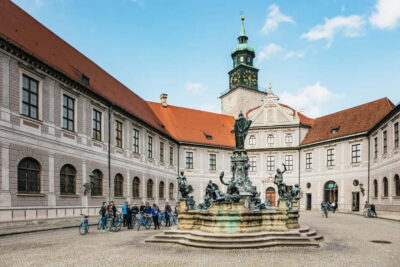 ★ 4.7Guided City Tour by Bike with Beer Garden StopFrom $53604 reviews
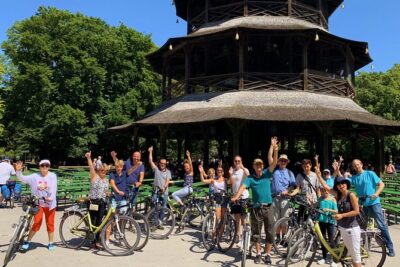 ★ 4.5Munich Small-Group Bike TourFrom $54510 reviews
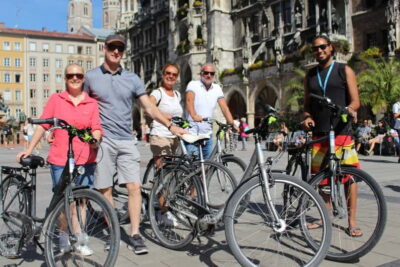 ★ 4.7Munich by Bike: Half-Day Tour with Local GuideFrom $53417 reviews
 ★ 4.9Munich Essentials Bike TourFrom $37401 reviews
 ★ 4.9Bike Tour with Beer Garden BreakFrom $47391 reviews
Browse the lists this tour appears in